field note
Everyone's Selling Pickaxes. T3 Code Is Mine, For Now.
AI is full of people selling pickaxes. This is the one I actually use. My second try at T3 Code turned my phone into a workshop and roughly quadrupled how often I ship.
- Published
- October 17, 2026
- Filed under
- field-note, agents, tools
There is an old line about gold rushes: the miners may or may not find gold, but every one of them needs picks and shovels. AI has taken that lesson to heart. A good chunk of my feed is people building tools for people who build with agents. There is even an AI agent company literally called Pickaxe.
So yes, this is a post about a pickaxe. I am not selling it. I just use it, a lot.
Last week I shipped code from a plane. Then from the back of an Uber, from hotel rooms, and from my work happy hour, more than once. At a wedding I sent one quick steer to an agent. Just one. I would like some credit for the restraint.
The only place I have not built from is behind the wheel. I want that on the record.
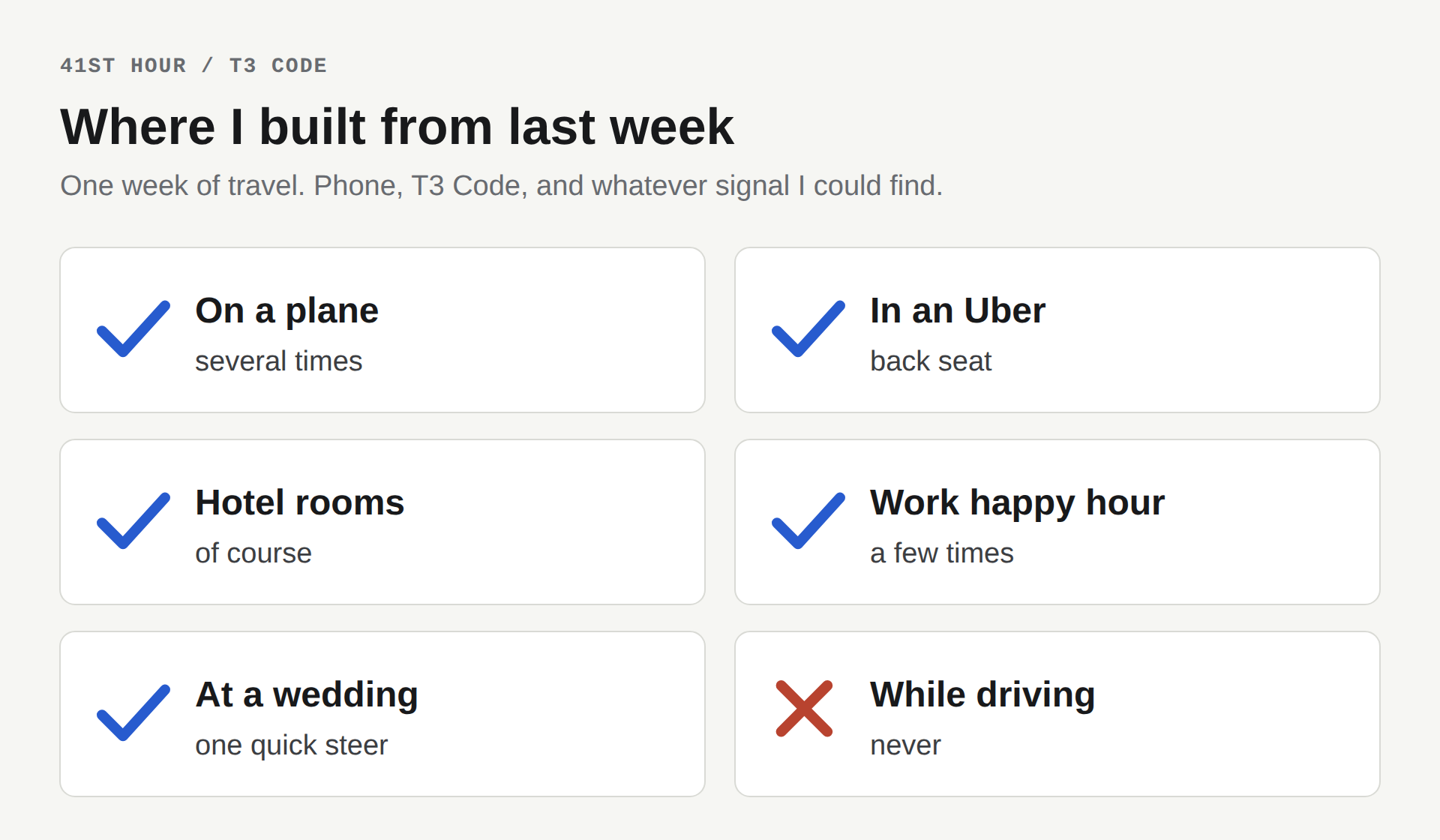
A month ago I was not doing any of this. I was building, but at a desk, in a terminal, a few pull requests a day. What changed is a tool called T3 Code, and how much it made me want to build again.
What T3 Code is
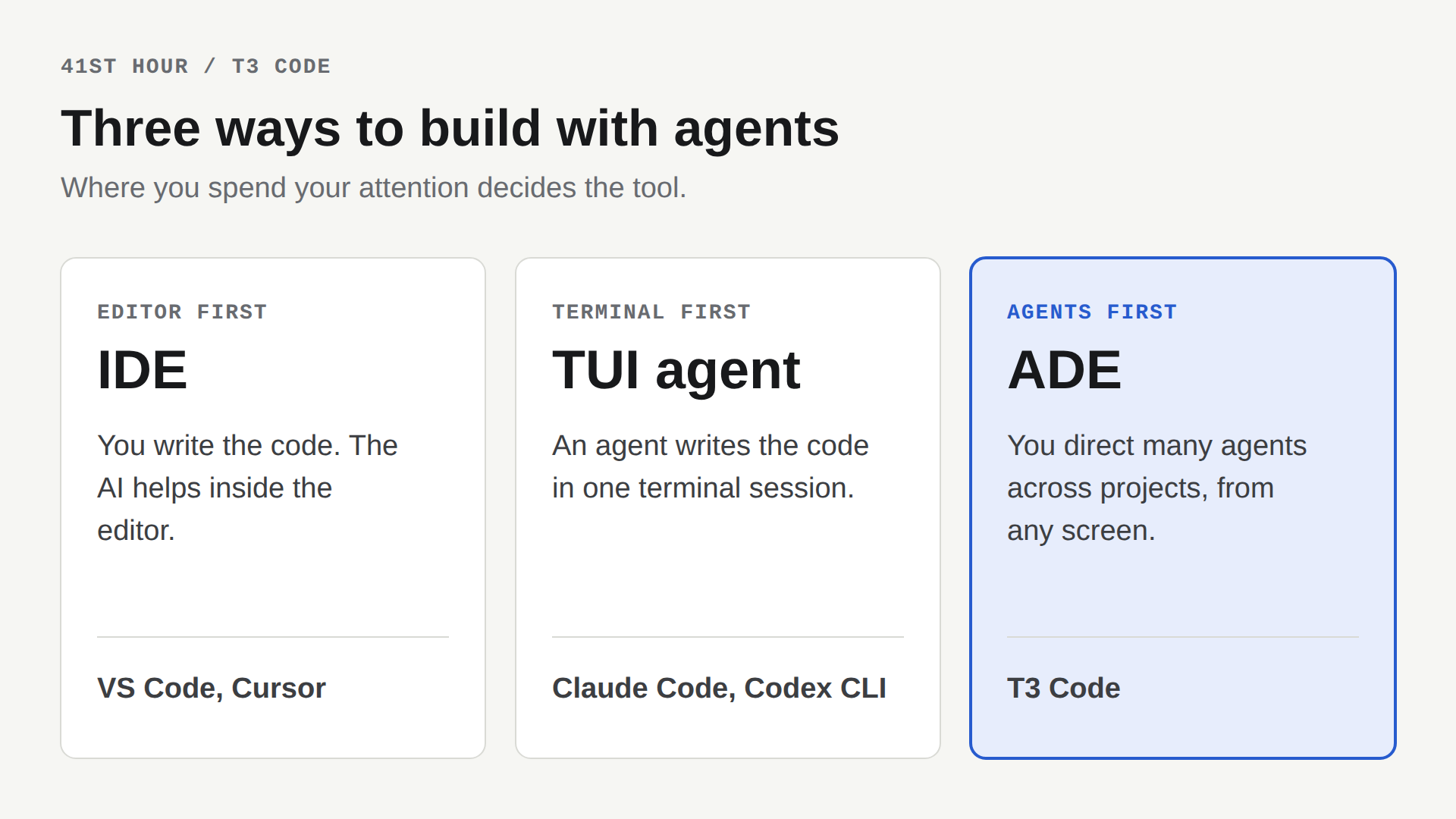
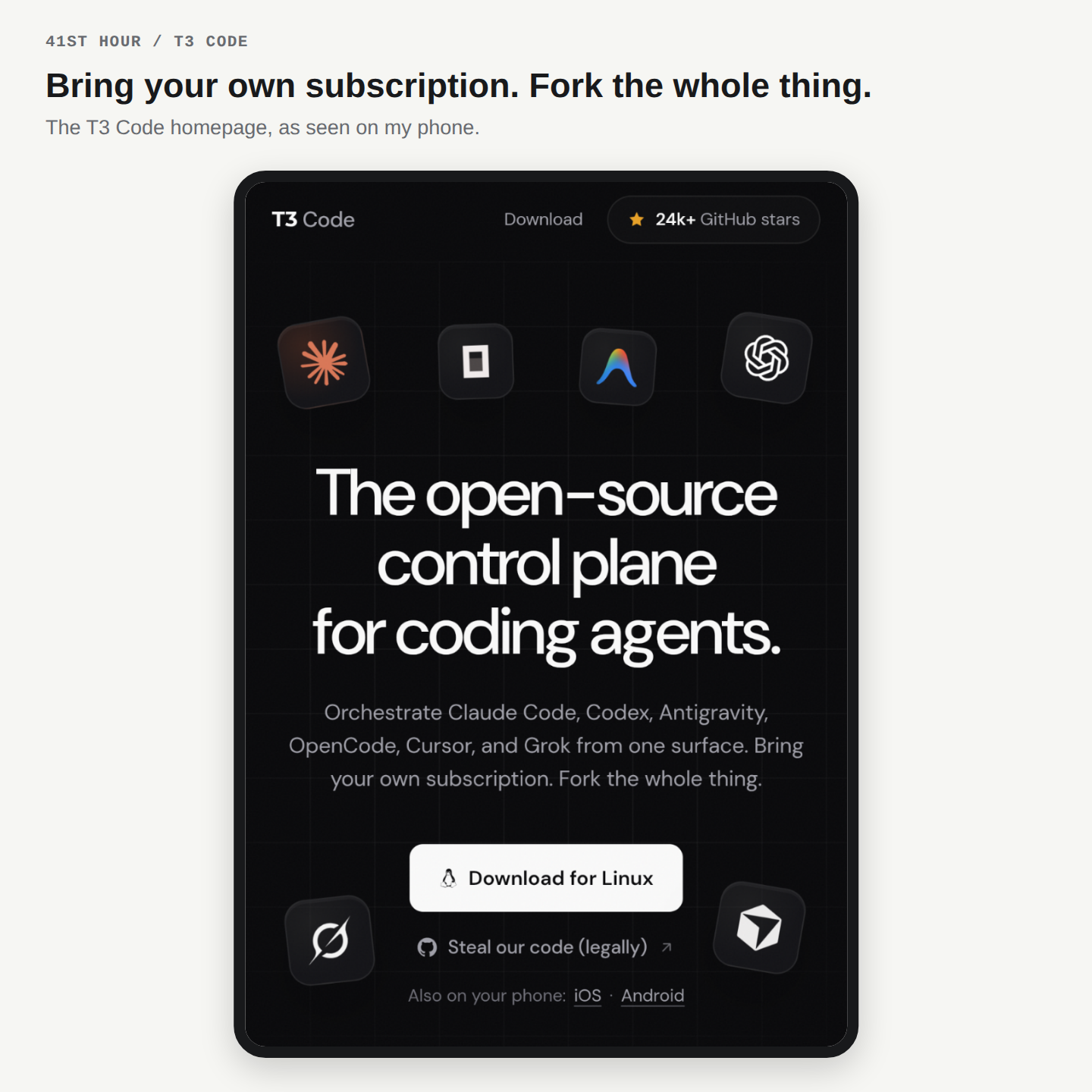
IDEs like VS Code and Cursor put AI next to your editor. Terminal agents like Claude Code and Codex CLI put it in a TUI. T3 Code belongs to a newer category that people have started calling ADEs, agent development environments. Its own README calls it an “agent harness control surface.” It does not replace Claude Code or Codex. It runs them, on the subscriptions you already pay for, and gives you one place to direct all of them from your desktop, a browser, or your phone.
How I found it, twice
I found T3 Code through Theo’s YouTube channel. Theo builds it with his team, and his channel is bleeding-edge AI content. I balance him out with ThePrimeagen, who comes at AI with a more skeptical, dare I say healthy, curiosity. I enjoy both and get real value from both, but I do not buy into either one 100%. Especially right now, I still have to think for myself. The point is not to repeat YouTube opinions, or worse, to become a meat proxy for an agent.
My first try came within a week or two of the launch, and it did not stick. I could not get remote hosts to work reliably, and the mobile app would not work for me either. Without those, it was a nice window with a model picker. So I went back to herdr, a terminal multiplexer, running Codex, the cursor-agent CLI, and Claude Code side by side.
Herdr is good. It let me run more agents at once than I ever had before. But it has the limits every multiplexer has, and some of my problems needed a real GUI. That part is personal. Herdr might be exactly right for you.
I had also built from my phone before, with the Claude and ChatGPT mobile apps connected to remote environments. It worked, and it still did not stick. I had a hard time keeping track of which thread was a cloud chat and which was a coding session on a remote host. Moving a discussion from chat into an actual build was clunkier than it should be.
Why I came back
In mid-September I downloaded X again, mostly for football. My feed was still mostly AI, since X is where AI news tends to show up first, and suddenly it was full of people using T3 Code. The app had grown up a lot since my first try, and FOMO did the rest. On September 30, I installed it again.
This time it stuck.
Why it stuck
The feature that hooked me sounds boring: the inbox. Every thread that needs my attention lands in one list. I answer one agent and move on to the next. On my phone, that turns into a loop. Thread to thread, project to project, and suddenly an hour is gone. I have not had this much fun building in a long time.
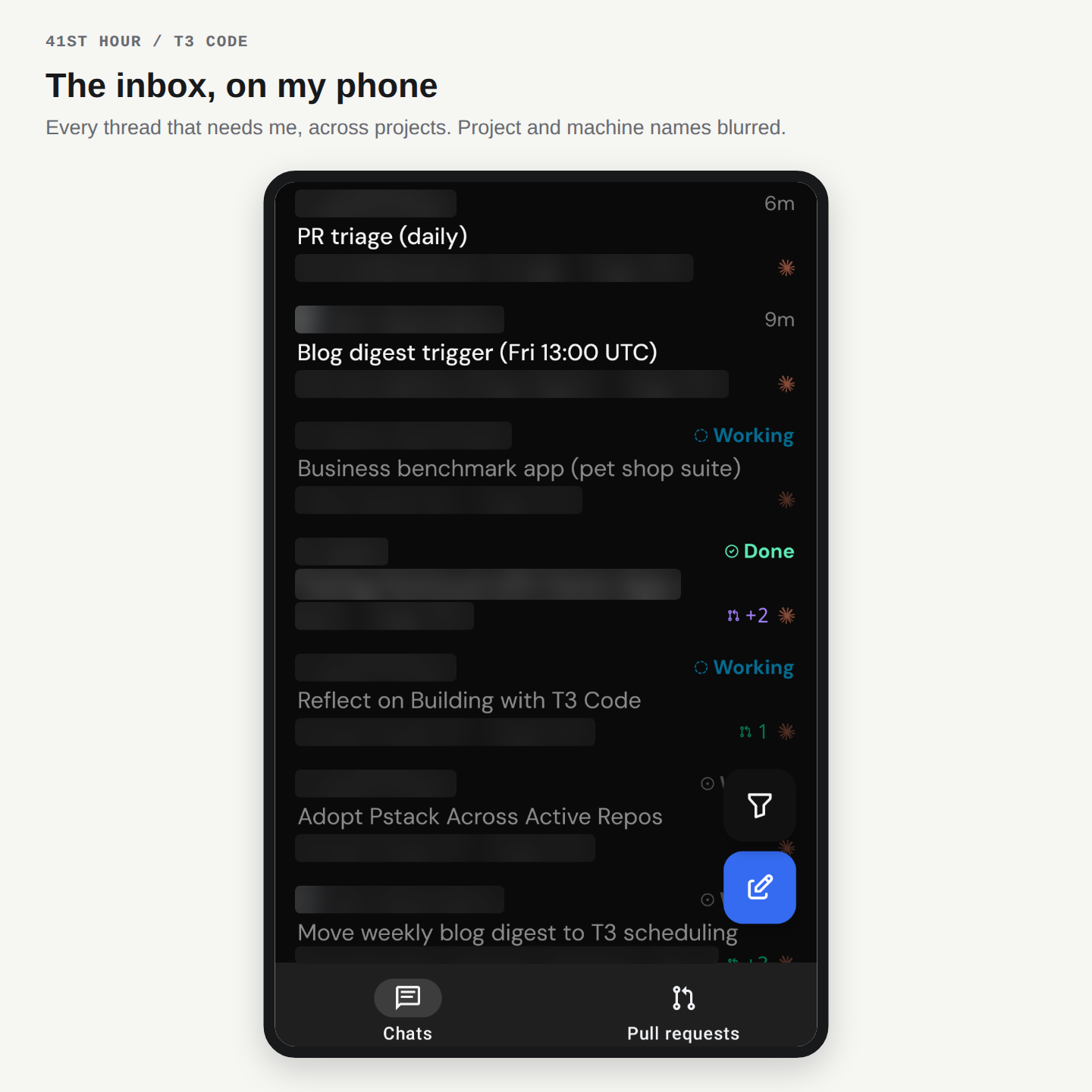
It also follows me around. I can start something in the T3 Code desktop app, leave the house, and pick up where I left off on my phone. Nothing to copy from a chat app into a coding tool. It is the same thread, with the same agent, on the same machine.
Version 0.1.0 made it even harder to put the phone down. Agents can now show diagrams, mockups, and whole HTML pages inside the thread, a bit like Codex does. I can look at the thing an agent made without opening a laptop.
In early September, Theo posted this:
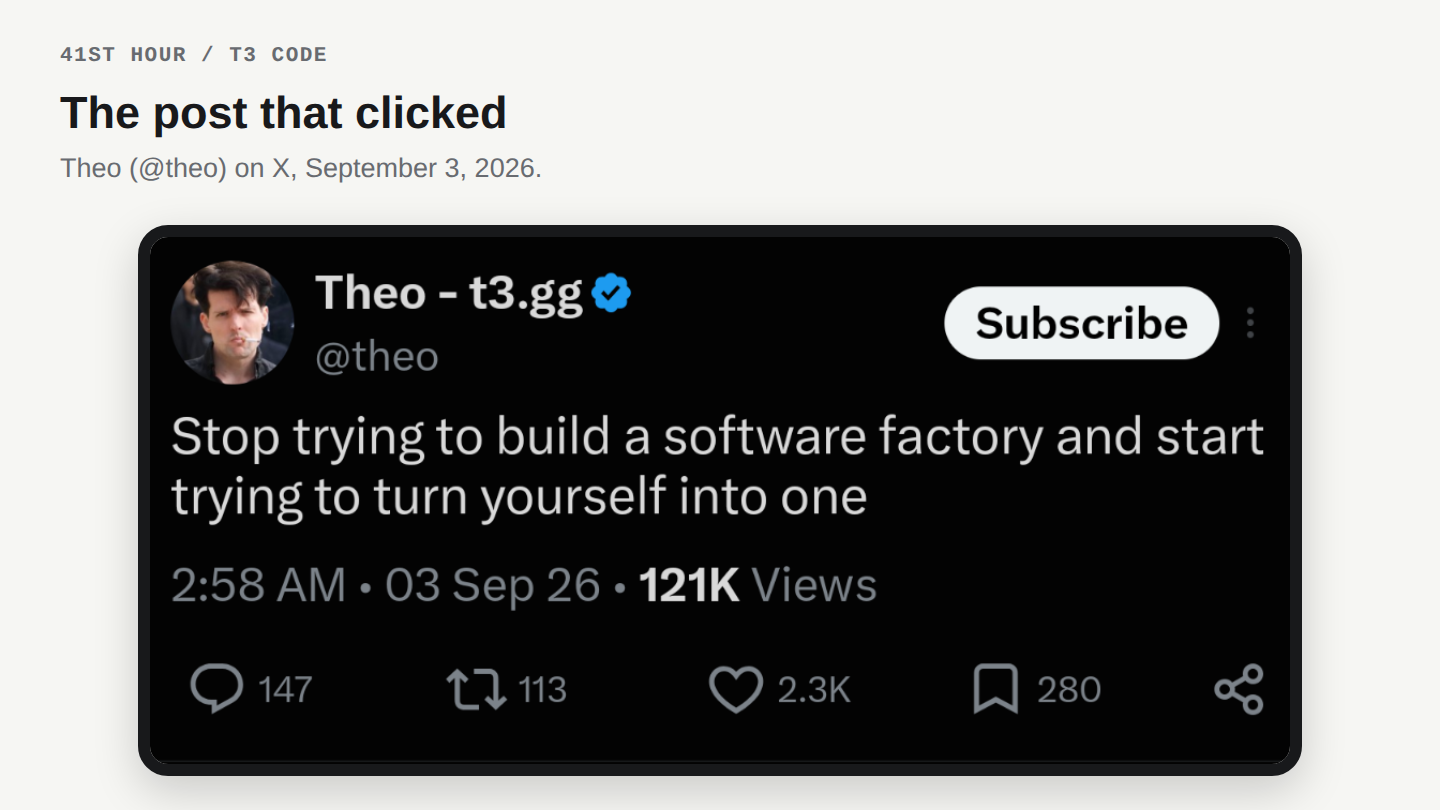
That post clicked for me after a few days with this setup.
What’s on the bench
So what am I building with all of this? Here is a sample.
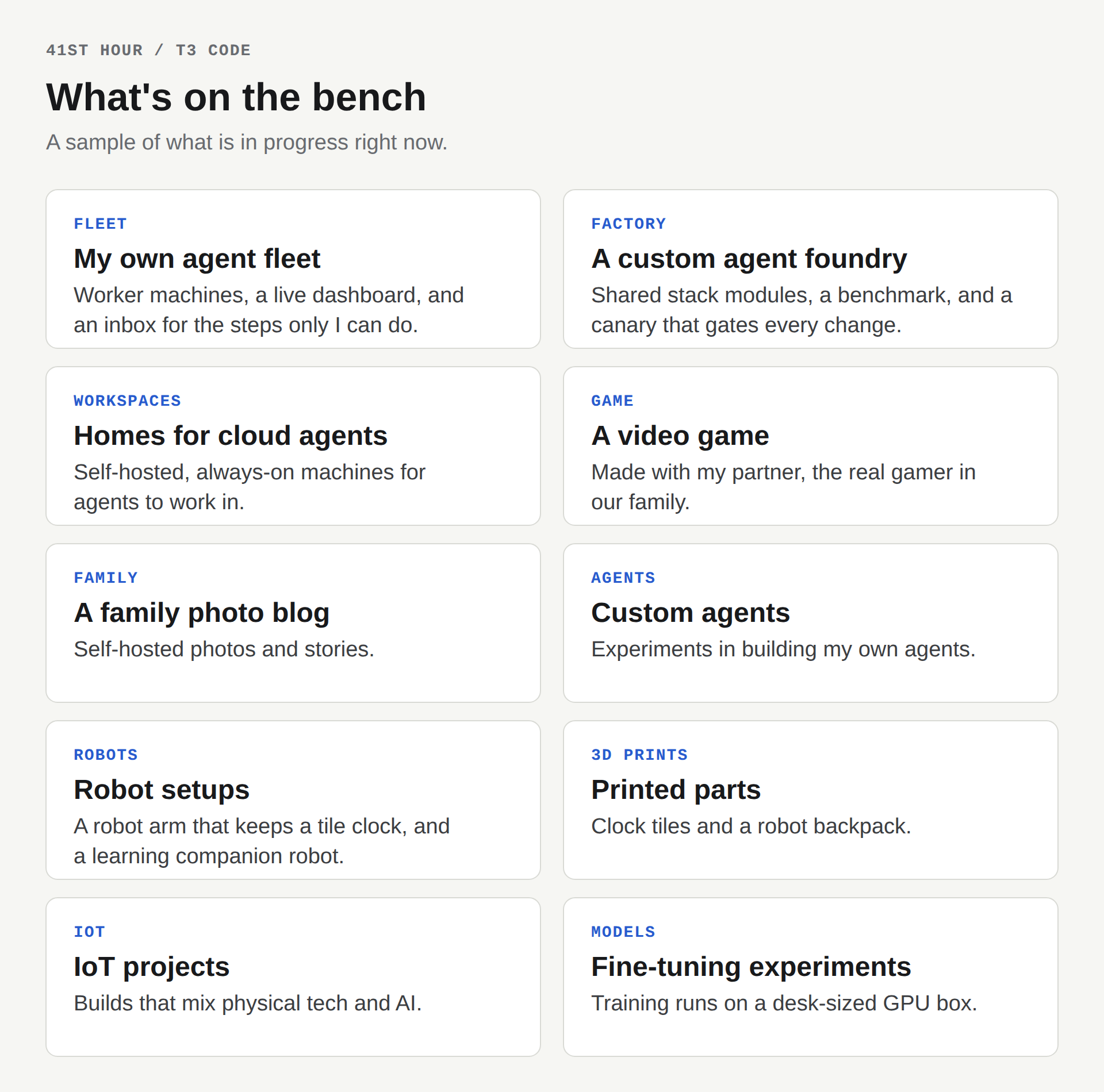
There is infrastructure for the building itself: my own agent fleet, a custom agent foundry that holds shared building blocks for my apps, and self-hosted, always-on homes where cloud agents can work without touching my laptop. There are experiments in building my own custom agents. There is a family photo blog. There is hardware: robot setups, 3D prints, and various IoT projects that combine physical tech and AI. And there is even a video game I am working on with my partner, who is the primary gamer in our family.
Even during my nine to five, when I am busy building on that side of life, my agents keep working in the background without demanding my attention. That lets me focus on what pays the bills. In the morning I kick off a few long-running agents, and after work I check back in to see what they did.
The numbers
Measuring productivity is hard, but pull requests are as good a measure as I have right now. These numbers come from GitHub search across every repo on my account, plus T3 Code’s own local database.
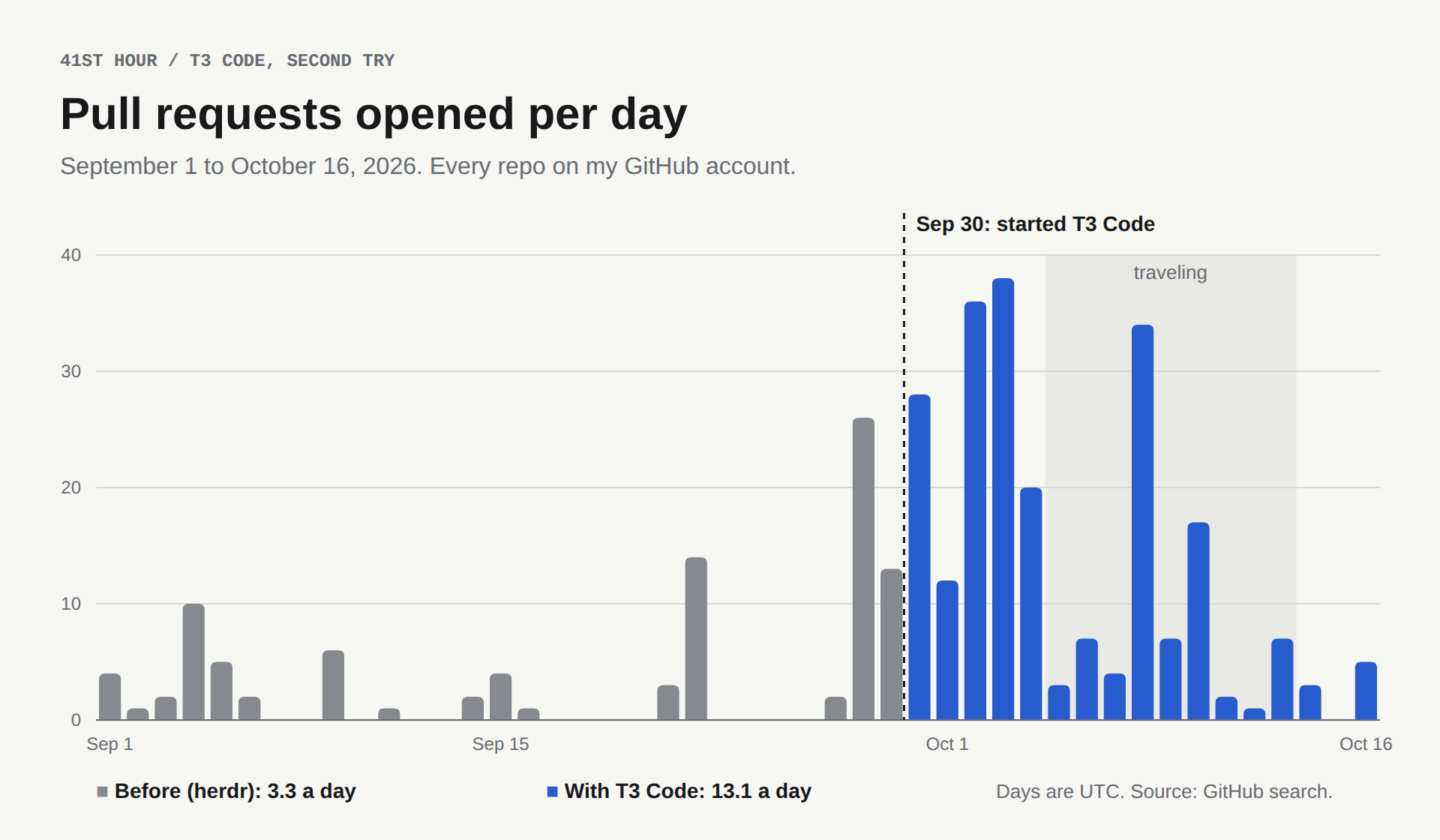
Comparing September 1 to 29 with September 30 to October 16:
- Pull requests opened per day went from 3.3 to 13.1.
- Pull requests merged per day went from 2.7 to 11.6.
- Commits per day went from 16.8 to 51.9.
- I started 9 new repos in those 29 days, and 11 in the next 17.
My first five days with T3 Code produced 134 pull requests, about 27 a day.
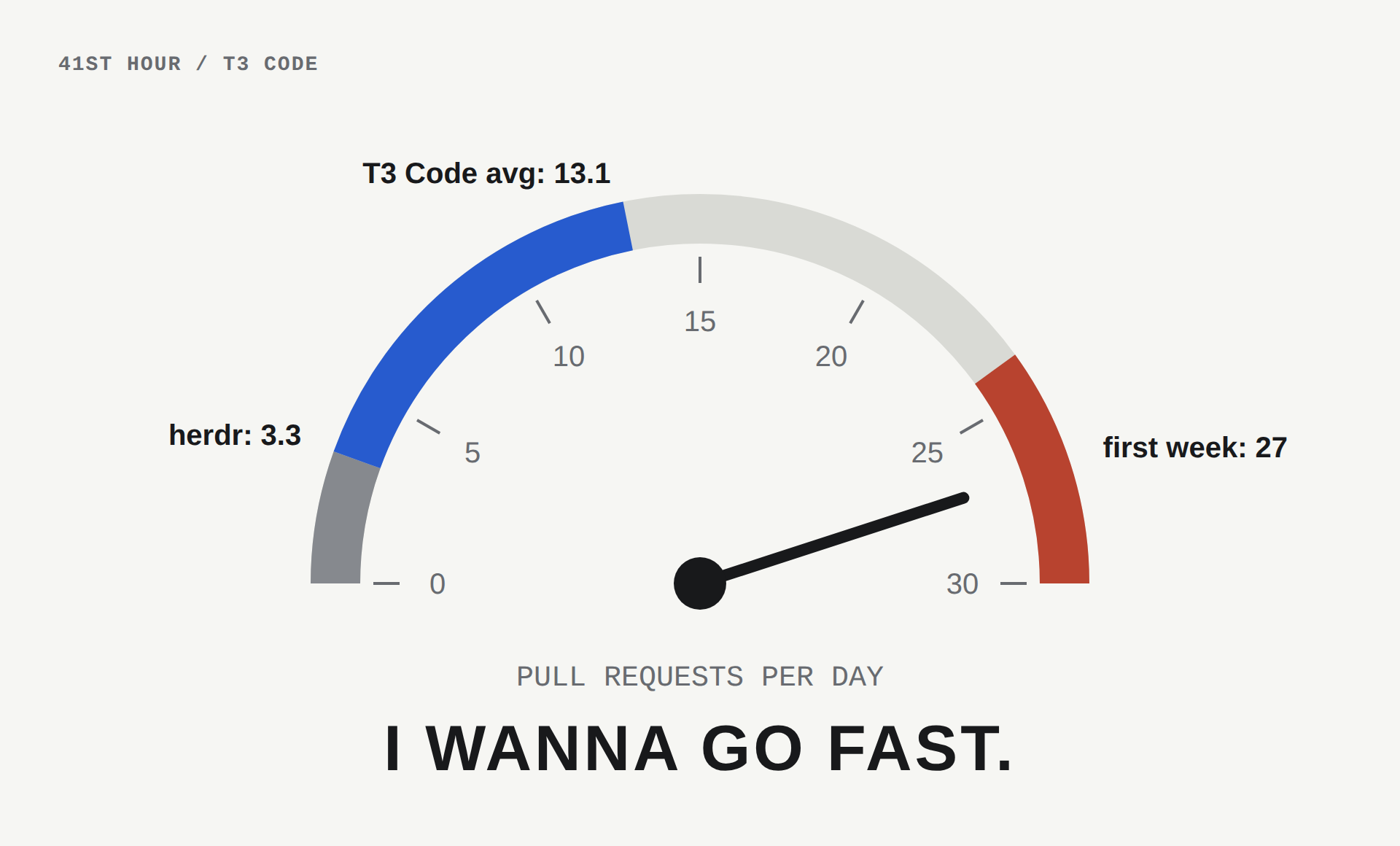
T3 Code’s own counts: 99 threads, 956 agent turns, and 180 pull requests linked to threads across 13 repos. The split between providers is close to even, with 54 Claude threads and 45 Codex threads.
My rate was already climbing in the last days of September, while I set up the machines I now run agents on. The T3 Code average also includes nine days of real life: travel, a wedding, and a work trip. I built less during that stretch, but I did not stop. The 34 pull request day in the middle of the travel band came from planes, hotel rooms, and the road. My custom agent experiments live on a machine that is offline right now, so they are not in these numbers at all.
The quirks
It is not perfect. Keeping T3 Code current across several machines, and keeping up with each agent harness’s own updates, could be cleaner. I mostly stay on the Stable channel, and Stable has mostly been exactly that.
The one real break came with the update to 0.1.0. My phone app refused to connect to my home server, even though every network check passed. I fixed it from my phone, over SSH in Termius. The cause was a half-applied auto-update on the server and a phone app that needed a newer server version. One t3 update and a fresh t3 pair --tailscale later, I was back. The lesson: when a client quietly refuses to connect and the network looks fine, check for a version mismatch first.
A few smaller things:
- Most of my other quirks came from my own Tailscale setup, not from T3 Code.
- I had trouble running the OpenCode 2 pre-release inside T3 Code. That seems fixed in 0.1.0 and the official OpenCode 2 release, but I have not tried it yet.
- T3 Code treats a delegated subagent and a new top-level thread as different things. I had to spell that out in my agent instructions, or a request for a subagent would open a whole new thread.
- I wish there were phone notifications for people like me who do not use T3 Connect. Right now push notifications require T3 Connect, and a direct or Tailscale connection does not get them.
The upside is that T3 Code is open source under the MIT license. If a missing feature like that bugs me enough, I can fork it and build on top of it myself.
Where I am now
When I want to build something, I reach for T3 Code first. Being able to build anywhere, at any time, is what won me over.
Herdr still gets opened, mostly by accident. I have a hotkey for it on my Omarchy install, and muscle memory sometimes gets there first. If I need a quick multiplexer-style task, I use it, and I still start an agent from it now and then.
Part of the fun is watching T3 Code get built in public. The team, Theo, Julius, and Maria, crowdsource features on X and post early builds and tests. A few days later, the feature shows up in the app.
Other ADEs are arriving, like BB and Paseo. The space moves fast, and the T3 team will have to keep shipping at this pace. I will try the others eventually. For now, T3 Code is my pickaxe of choice.